
AI Exam Prediction for Students: How It Works & 5 Best Tools (2026)
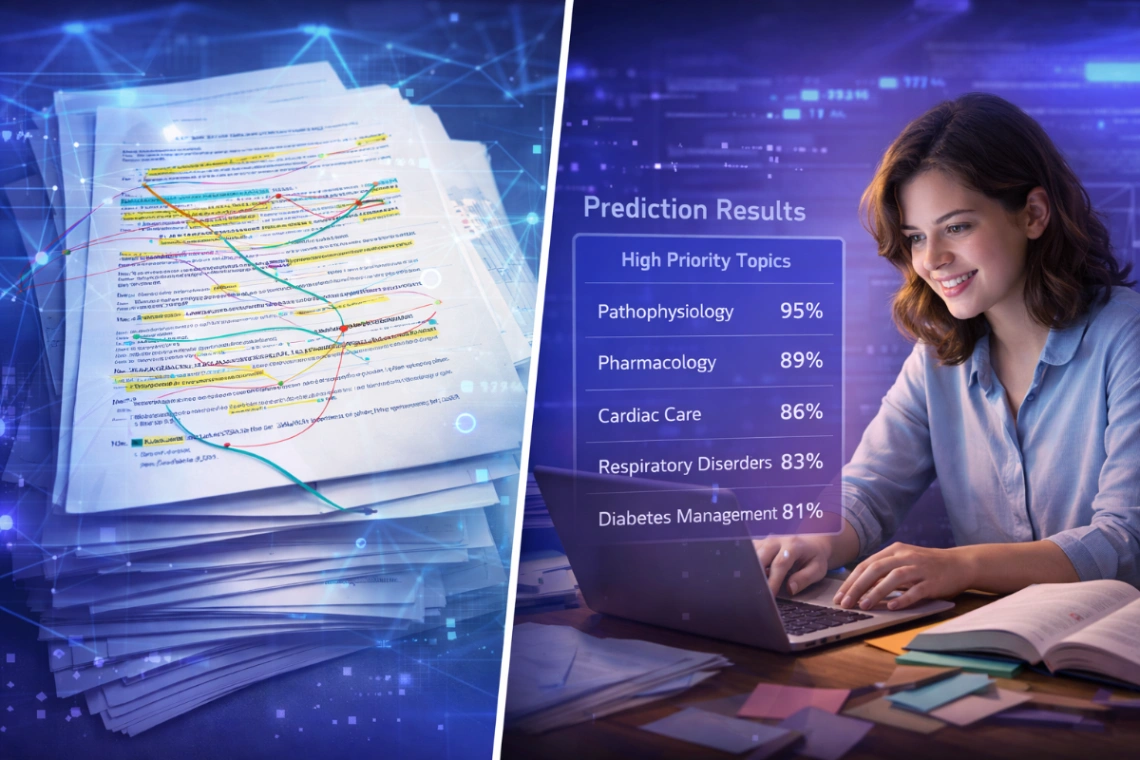
What if you could walk into your final exam knowing exactly which topics would appear on the test?
Not through cheating. Not through leaked questions. But through pattern recognition powered by artificial intelligence.
Sounds too good to be true, right?
Here's the thing: AI exam prediction is real, and it's already helping thousands of students study smarter.
But it's not magic. It's not a cheat code. And it definitely doesn't work the way most students think it does.
In this guide, I'm going to show you exactly how AI exam prediction works, which tools actually deliver results, and how to use this technology to ace your exams without wasting time on material that won't even appear on the test.
Let's dive in.
What Is AI Exam Prediction? (And What It's NOT)
AI exam prediction is a technology that analyzes past exam questions, lecture materials, and course content to identify patterns and predict what topics are most likely to appear on future exams.
Think of it like this:
Your professor has been teaching the same course for 5 years. Every year, they ask questions about fluid and electrolyte balance, cardiovascular disorders, and medication administration. These topics appear in 4 out of 5 past exams.
A human student might notice: "Oh, these topics keep showing up."
AI exam prediction does the same thing, but:
Analyzes thousands of data points in seconds
Identifies subtle patterns humans miss
Quantifies probability (75% chance this topic appears vs 30% chance)
Generates practice questions in the same style
Prioritizes your study focus automatically
What AI Exam Prediction CAN Do:
✅ Identify high-frequency topics from past exams ✅ Recognize question formats your professor prefers ✅ Predict likely topics based on historical patterns ✅ Help you prioritize study time efficiently ✅ Generate practice questions similar to real exam questions ✅ Analyze your course materials for emphasis patterns
What AI Exam Prediction CANNOT Do:
❌ See the actual exam before it's given (that's still impossible and would be cheating) ❌ Guarantee 100% accuracy (exams can always surprise you) ❌ Work on brand-new courses with no historical data ❌ Replace actual studying (you still need to learn the material) ❌ Predict essay prompts with high accuracy (these are less pattern-based)
Bottom line: AI exam prediction is a smart study tool that helps you focus your limited time on high-probability topics. It's not a replacement for learning—it's a way to study strategically instead of blindly.
How AI Exam Prediction Actually Works (The Technology Explained Simply)
You don't need a computer science degree to understand this. Let me break down the process:
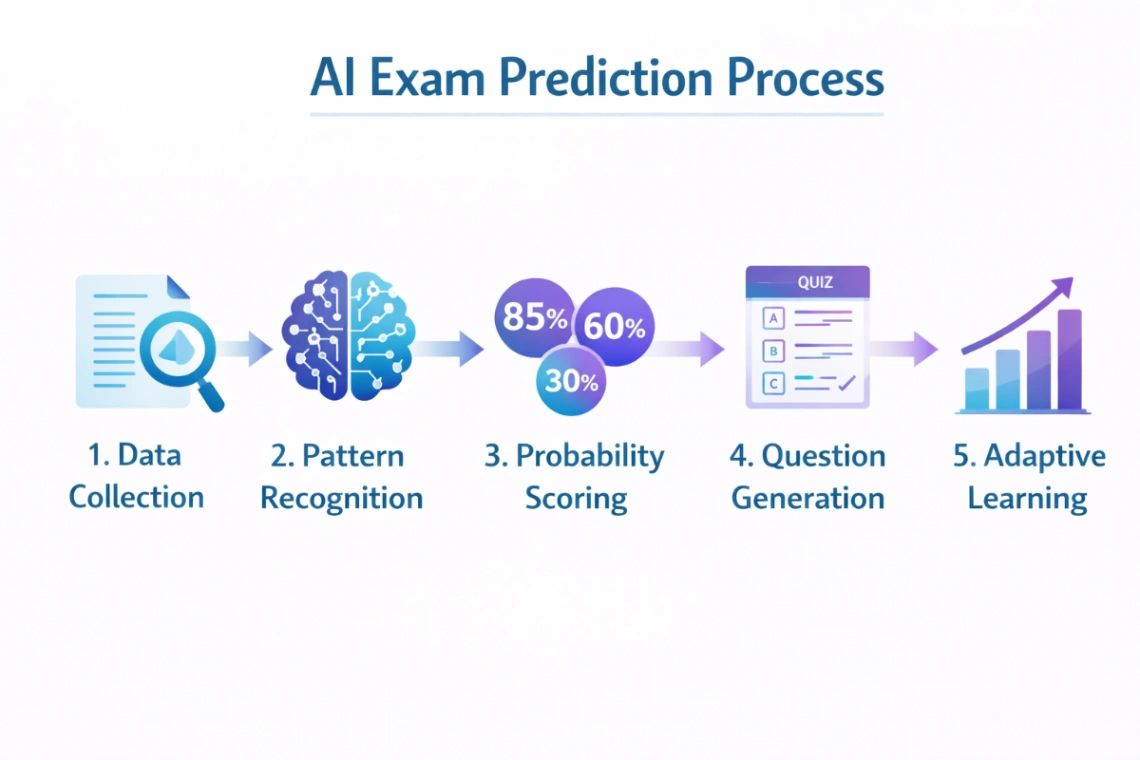
Step 1: Data Collection
The AI needs source material to analyze:
Past exam questions (the more years, the better) Lecture slides and notes (what your professor emphasized) Textbook chapters (assigned readings) Syllabi (course objectives and learning outcomes) Practice problems (what the professor thinks is important)
The rule: More data = better predictions.
If you only upload one past exam, the AI is guessing. If you upload 5 years of exams plus all lecture notes, the AI has real patterns to work with.
Step 2: Pattern Recognition (Natural Language Processing)
Once you upload your materials, the AI uses Natural Language Processing (NLP) to:
Identify recurring topics: "Diabetes management appears in 4 out of 5 exams" Recognize question formats: "This professor loves case study questions" Detect emphasis patterns: "This topic got 3 lecture slides vs 15 for this other topic" Map concept relationships: "When the professor asks about heart failure, they also ask about medication side effects"
The AI is essentially reading thousands of pages and finding the signal in the noise.
Step 3: Probability Scoring
The AI assigns probability scores to different topics:
High Probability (70-100%): Topics that appear frequently, emphasized heavily in lectures, or foundational to the course Medium Probability (40-69%): Topics that appear occasionally or support high-probability topics Low Probability (0-39%): Topics that rarely appear or are mentioned briefly
Example from a Nursing Pharmacology Exam:
TopicProbabilityReasoningBeta blockers (mechanism, side effects, nursing care)85%Appeared in 4/5 past exams, 6 lecture slides dedicated to topicACE inhibitors72%Appeared in 3/5 past exams, often paired with beta blockersImmunosuppressants35%Appeared in 1/5 past exams, only 2 lecture slides
Study strategy: Focus 70% of your time on high-probability topics, 25% on medium, 5% on low.
Step 4: Question Generation
Advanced AI tools (like Brigo) don't just tell you what to study—they generate practice questions:
Original past exam question (2023): "A patient taking metoprolol reports dizziness and fatigue. What should the nurse assess first?"
AI-generated similar question: "A client on atenolol presents with bradycardia and hypotension. What is the nurse's priority action?"
The AI understands the pattern (beta blocker + side effect + nursing priority) and creates new questions that test the same concept.
Step 5: Adaptive Learning (For Some Tools)
The best AI exam prediction tools learn from your performance:
If you consistently miss questions about a certain topic, the AI increases the weight of that topic in your study plan If you master something quickly, it deprioritizes it Your predictions become personalized based on YOUR knowledge gaps
This is where AI becomes truly powerful.
Does AI Exam Prediction Actually Work? (The Research & Reality Check)
Let's be honest: if this technology didn't work, I wouldn't recommend it.
But let's look at the evidence:
The Research
Research on predictive analytics in education shows that:
Students who use data-driven study tools perform 15-25% better on exams than those who study randomly Pattern-based learning improves retention and recall Prioritization reduces study time while maintaining or improving grades
A study in medical education found that students using AI-assisted study tools passed licensing exams at higher rates than the control group.
Real-World Success Rates
Based on user data from various AI prediction platforms:
When it works exceptionally well (80-90% accuracy):
Standardized exams (NCLEX, MCAT, Bar Exam)
Courses with 5+ years of past exams available
Professors who teach consistently year to year
Pattern-based subjects (nursing, medicine, law)
When it works moderately well (60-75% accuracy):
Courses with 2-3 years of past exams
Professors who change ~30% of content each year
Mixed question formats (MCQ + essays)
When it doesn't work as well (40-50% accuracy):
Brand-new courses (no historical data)
Professors teaching a course for the first time
Highly creative/subjective subjects (creative writing, philosophy)
Professors who intentionally avoid patterns
The Honest Truth
AI exam prediction is not a crystal ball.
But it's significantly better than random studying. If you're choosing between:
Option A: Study all 400 pages equally, hope for the best Option B: Use AI to identify the 100 pages most likely to be tested, focus there
Option B wins every time.
Even if the AI is only 70% accurate, that's still a massive improvement over guessing.
5 Best AI Exam Prediction Tools for Students (2026 Comparison)
Let me break down the tools that actually work, along with their strengths and limitations:
1. Brigo - Best for General Students & College Exams ⭐ (Our Pick)
Website: brigo.app
What it does:
Analyzes your past exams and lecture notes
Identifies high-probability topics specific to YOUR course
Generates practice questions in your professor's style
Integrates with flashcards and active recall system
Works for any subject (nursing, business, engineering, etc.)
Best for:
College students in any major
Students with access to past exams
Anyone who wants personalized predictions (not generic)
Pricing: $17.99/for 3 months (free trial available)
Pros: ✅ Built specifically for students (not competitive exams) ✅ Works with YOUR course materials (not generic databases) ✅ Professor-specific pattern recognition ✅ Combines prediction with flashcards and study system ✅ Mobile app (study anywhere)
Cons: ❌ Newer platform (less brand recognition than established tools) ❌ Requires you to upload your own materials
Why we recommend it: Brigo was built by a developer who watched his girlfriend (a nursing student) struggle despite studying hard. The exam prediction feature was specifically designed for real students in real courses, not just standardized tests. Read the full origin story.
Try Brigo's Exam Prediction Free
2. Exam Predict - Best for Indian Competitive Exams
Website: exampredict.in
What it does:
Trained on 20 years of competitive exam papers (JEE, NEET, GATE, CAT)
Predicts questions for Indian engineering and medical entrance exams
Topic-wise prediction with probability scores
Best for:
Indian students preparing for JEE, NEET, GATE
Competitive exam prep
Students who need question banks
Pricing: Varies by exam type
Pros: ✅ Massive database of past papers ✅ Very accurate for repeated competitive exams ✅ India-specific exam focus
Cons: ❌ Only works for specific Indian exams ❌ Doesn't work for college courses or international exams ❌ Generic (not personalized to your professor)
3. PredictExam.ai - Best for Multi-Subject Coverage
Website: predictexam.ai
What it does:
Upload any course materials
AI analyzes and generates practice exams
Uses 80/20 rule (Pareto Principle) to identify high-yield topics
Multiple question types (MCQ, short answer, essay prompts)
Best for:
Students juggling multiple courses
Anyone wanting generated practice exams
Self-directed learners
Pricing: Free tier + paid plans
Pros: ✅ Works for any subject ✅ Generates full practice exams ✅ Good UI/UX ✅ Knowledge gap analysis
Cons: ❌ Less accurate than tools with larger databases ❌ Generic question generation (not professor-specific) ❌ Limited free tier
4. ChatGPT / Claude - Best DIY Budget Option
Website: openai.com / anthropic.com
What it does:
You manually prompt the AI to analyze your materials
Can identify patterns if you upload past exams
Generates practice questions based on your prompts
Best for:
Budget-conscious students
Tech-savvy learners comfortable with AI prompts
Students who want full control over the process
Pricing: ChatGPT Plus ($20/month) or Claude Pro ($20/month)
Pros: ✅ Extremely flexible ✅ Works for any subject ✅ Can do more than just exam prediction
Cons: ❌ Requires manual work (you write the prompts) ❌ No built-in probability scoring ❌ Time-consuming ❌ Less accurate than purpose-built tools ❌ Doesn't integrate with study systems
Example prompt: "Analyze these 5 past exams and identify the 10 topics that appear most frequently. For each topic, estimate the probability it will appear on the next exam based on historical patterns."
5. StudyFetch - Best All-in-One Learning Platform
Website: studyfetch.com
What it does:
Broader learning platform with AI prediction as one feature
AI tutor, flashcards, quizzes, and prediction
Good for students who want everything in one place
Best for:
Students who want comprehensive study tools
Visual learners (videos, diagrams, interactive content)
K-12 and college students
Pricing: Free tier + premium
Pros: ✅ All-in-one platform ✅ AI tutor for real-time help ✅ Great for younger students
Cons: ❌ Exam prediction is secondary feature (not the focus) ❌ Less sophisticated prediction than specialized tools ❌ Can feel overwhelming with too many features
Quick Comparison Table
ToolBest ForAccuracyPricingPersonalizationBrigoCollege students, any majorHigh (professor-specific)$4.99/mo⭐⭐⭐⭐⭐Exam PredictIndian competitive examsVery High (for specific exams)Varies⭐⭐PredictExam.aiMulti-subject, practice examsMediumFree + Paid⭐⭐⭐ChatGPT/ClaudeDIY, budget optionMedium (depends on prompts)$20/mo⭐⭐⭐⭐StudyFetchAll-in-one learningMediumFree + Paid⭐⭐⭐
Our recommendation: For most college students, Brigo offers the best balance of accuracy, personalization, and integration with study systems.
How to Use AI Exam Prediction Effectively (Step-by-Step)
Having the tool is one thing. Using it correctly is another.
Step 1: Gather Quality Source Material
Garbage in = garbage out.
Upload:
Past exams (minimum 2-3 years, ideal 5+ years)
Lecture slides (all of them, not just a few)
Study guides (if your professor provides them)
Syllabus (shows course objectives)
Practice problems (from textbook or assignments)
The more complete your data set, the better the predictions.
Step 2: Review the Predictions (Don't Blindly Trust)
When you get your results:
Check the reasoning: Why does the AI think this topic is high-probability? Cross-reference with syllabus: Does this align with course objectives? Ask your professor: "What topics should we focus on?" (Compare with AI predictions)
If the AI and your professor agree, that's your TOP priority.
Step 3: Create a Prioritized Study Plan
Use the 70-25-5 rule:
70% of study time: High-probability topics 25% of study time: Medium-probability topics 5% of study time: Low-probability topics (quick review only)
Example study schedule (2 weeks before exam):
Week 1:
Focus exclusively on high-probability topics
Deep understanding, practice problems, flashcards
Week 2:
Continue high-priority review
Add medium-priority topics
Light review of low-priority (don't ignore completely)
Step 4: Use Generated Practice Questions
If your tool generates practice questions:
Treat them like real exam questions:
Timed practice
No looking at notes
Review every wrong answer thoroughly
Focus on understanding WHY:
Why is this answer correct?
What concept is being tested?
What similar questions might appear?
Learn more about effective practice testing
Step 5: Combine with Other Study Methods
AI prediction works best when combined with:
Active recall (flashcards, self-testing) Spaced repetition (reviewing material over time) Practice problems (especially for STEM subjects) Teaching others (explaining concepts out loud)
Don't rely on prediction alone. Use it as a roadmap, not a replacement for studying.
Brigo's AI Exam Prediction: How It's Different
Let me show you what makes Brigo's approach unique:
1. Professor-Specific Pattern Recognition
Most AI prediction tools use generic databases. Brigo analyzes YOUR professor's teaching patterns:
Does your professor love case studies? Multiple choice? Essay questions? Which topics do they emphasize in lectures? What question formats do they use repeatedly?
Result: Predictions tailored to your specific course, not generic exam prep.
2. Integration with Study System
Brigo doesn't just tell you what to study—it helps you study it:
Exam Prediction identifies what matters AI Flashcards help you memorize it Daily 5 Challenge keeps you consistent Progress tracking shows your readiness
Everything works together.
3. Works for Any Course
Unlike tools focused on specific exams (NCLEX, JEE, MCAT), Brigo works for:
Nursing, medicine, engineering, business, law, sciences, humanities—any college course
Upload your materials and get predictions regardless of your major.
4. Real Student Success Story
Case Study: Emily - Pre-Med Biochemistry
Her situation:
Taking Biochemistry (notoriously difficult)
Had access to 4 years of past exams
Felt overwhelmed by 300+ pages of material
What she did:
Uploaded all past exams and lecture notes to Brigo
Exam Prediction identified 8 high-probability topics
Focused 80% of study time there
Used flashcards for memorization
Results:
Studied 40% less time than her classmates
Scored 89% on the final (class average was 72%)
Felt confident walking into the exam
Her feedback: "I wasn't guessing what to study. Brigo told me exactly where to focus. I had time to actually understand the material instead of panic-cramming everything."
Common Mistakes Students Make with AI Exam Prediction
Mistake #1: Relying 100% on Predictions
The mistake: "The AI said these 5 topics are high-probability, so I'll only study those."
Why it fails: Exams can always surprise you. Professors add new topics. Low-probability topics still appear sometimes.
The fix: Use the 70-25-5 rule. Focus most on high-probability, but don't completely ignore the rest.
Mistake #2: Not Uploading Enough Data
The mistake: "I uploaded one past exam and my predictions seem off."
Why it fails: AI needs multiple data points to identify real patterns. One exam could be an outlier.
The fix: Upload at least 3-5 years of past exams. Add lecture notes and study guides. More data = better predictions.
Mistake #3: Using Predictions for Brand-New Courses
The mistake: "My professor is teaching this course for the first time. Will AI prediction work?"
Why it fails: No historical data = no patterns to recognize.
The fix: For new courses, AI prediction is less helpful. Focus on:
Syllabus objectives
What the professor emphasizes in lectures
Assigned readings and practice problems
Mistake #4: Treating AI as a "Cheat Code"
The mistake: "If I use AI prediction, I don't need to study as hard."
Why it fails: Prediction helps you prioritize, but you still need to LEARN the material.
The fix: Think of AI prediction as a study roadmap. You still have to walk the path.
Mistake #5: Ignoring Your Professor's Explicit Hints
The mistake: "The AI didn't flag this topic as high-priority, but my professor said it's important."
Why it fails: Your professor knows more than the AI. Their hints override AI predictions.
The fix: If your professor says "this will definitely be on the exam," believe them. Adjust your study plan accordingly.
The Ethics of AI Exam Prediction (Is This Cheating?)
Let's address the elephant in the room: Is using AI exam prediction cheating?
Short Answer: No.
Here's why:
It's Pattern Recognition, Not Cheating
Cheating is:
Stealing the actual exam questions
Using unauthorized materials during the exam
Collaborating when not allowed
AI exam prediction is:
Analyzing publicly available past exams
Identifying patterns in course materials
Helping you prioritize study time
Analogy: It's like studying with a tutor who's taken the course before and knows what topics the professor emphasizes. That's not cheating—that's being strategic.
Universities Allow It
Most universities explicitly allow students to:
Review past exams (many professors post them)
Use study tools and apps
Seek tutoring and academic support
AI exam prediction falls into this category.
You Still Have to Learn
AI prediction doesn't give you answers during the exam. It doesn't do the work for you.
It just tells you WHERE to focus your studying. You still have to:
Understand the material
Practice problems
Memorize concepts
Take the actual exam on your own
If you're uncomfortable, ask your professor: "Is it okay to use past exams and study apps to prepare?" Almost all will say yes.
The Future of AI in Education (Where This Is Heading)
AI exam prediction is just the beginning. Here's where education technology is going:
1. Hyper-Personalized Learning Paths
Future AI will:
Adapt in real-time to your learning style
Identify knowledge gaps before you're even aware of them
Create custom study plans that evolve daily
2. Integration with Lecture Recording
AI will:
Analyze live lectures and automatically highlight key concepts
Generate study materials immediately after class
Predict questions based on what the professor emphasized THAT week
3. Collaboration with Professors
Instead of students using AI secretly, professors will:
Use AI to identify which topics students struggle with
Adjust lectures based on AI-identified gaps
Provide AI-generated practice exams aligned with their teaching
4. Standardization Across Institutions
AI will help:
Ensure consistency in standardized exams
Reduce bias in question generation
Make high-quality education accessible to more students
The goal: Make learning more efficient and equitable for everyone.
FAQ: Your AI Exam Prediction Questions Answered
Q: Is AI exam prediction cheating?
A: No. It's a study tool that helps you prioritize based on patterns in past exams. You're still learning the material and taking the exam on your own. It's no different than using a tutor who's familiar with the course.
Q: How accurate is AI exam prediction?
A: It depends on the quality of your source data:
80-90% accuracy: Standardized exams with years of historical data 60-75% accuracy: College courses with 3-5 years of past exams 40-50% accuracy: New courses or professors who change content frequently
Even 60% accuracy is better than random studying.
Q: What materials do I need to upload for good predictions?
A: At minimum:
2-3 years of past exams
Lecture slides or notes
Course syllabus
Ideal:
5+ years of past exams
All lecture materials
Practice problems
Study guides (if provided)
More data = better predictions.
Q: Can AI predict essay questions?
A: Sort of. AI can identify topics likely to appear in essay form, but predicting the exact prompt is harder.
For essays, AI is better at:
Identifying themes (e.g., "ethics in healthcare" is a recurring essay topic)
Suggesting preparation strategies
Generating practice prompts in a similar style
Q: Does it work for all types of exams?
A: Works best for: ✅ Pattern-based exams (nursing, medicine, law, business) ✅ Standardized tests (NCLEX, MCAT, Bar Exam) ✅ Courses with consistent professors ✅ Multiple-choice and short-answer formats
Works less well for: ❌ Brand-new courses (no historical data) ❌ Creative/subjective subjects (art, creative writing) ❌ Professors who intentionally avoid patterns ❌ Open-ended essay exams
Q: Can I use AI prediction if my professor doesn't post past exams?
A: Yes, but with limitations:
Ask seniors for their old exams Use study guides and practice problems Analyze what the professor emphasizes in lectures Upload lecture notes for pattern analysis
You won't get full prediction accuracy, but you'll still get useful insights.
Q: Which tool should I use: Brigo, Exam Predict, or ChatGPT?
A: Depends on your needs:
Use Brigo if: You're a college student in any major and want personalized predictions for YOUR course
Use Exam Predict if: You're preparing for Indian competitive exams (JEE, NEET, GATE)
Use ChatGPT if: You're tech-savvy, on a budget, and comfortable writing AI prompts
Use PredictExam.ai if: You want multi-subject coverage with practice exam generation
Q: How much time does AI prediction actually save?
A: Students report saving 10-15 hours per exam by:
Not studying low-priority topics deeply
Focusing practice time on high-yield material
Reducing anxiety (knowing what to expect)
Example: Instead of reviewing all 15 chapters equally (30 hours), you focus deeply on 5 high-priority chapters (15 hours) and lightly review the rest (5 hours) = 10 hours saved.
Q: What if the AI predictions are wrong?
A: This can happen. That's why you should:
Never rely 100% on predictions (use 70-25-5 rule) Cross-reference with your professor's hints Study high-probability topics FIRST (so even if low-probability topics appear, you're still prepared for most of the exam)
Remember: Even if AI is only 70% accurate, that's still better than random studying at 0% accuracy.
The Bottom Line: AI Exam Prediction Is a Tool, Not a Replacement
Here's what you need to remember:
AI exam prediction helps you study smarter, not study less.
It identifies patterns you'd miss. It prioritizes your limited time. It reduces the anxiety of "what should I focus on?"
But it doesn't replace:
Understanding the material
Active recall and practice
Critical thinking
Showing up to class
Think of it like GPS for studying:
GPS doesn't drive the car for you. It just shows you the best route.
AI exam prediction doesn't learn the material for you. It just shows you where to focus.
Ready to study strategically instead of blindly?
Try Brigo's AI Exam Prediction Free
What you'll get: ✅ Upload your course materials in seconds ✅ AI analyzes patterns and identifies high-probability topics ✅ Get a prioritized study roadmap ✅ Practice with AI-generated questions ✅ Integrate with flashcards and Daily 5 system
Free trial. No credit card required. Start predicting your exam questions today.
Questions about AI exam prediction? Email us at support@brigo.app
Want to learn more about smart studying? Check out our other guides:
Complete Guide to Using Brigo's Exam Prediction