
How to Master Active Recall with AI Flashcards | Brigo Study Guide
You're three pages into your Biochemistry textbook. Your eyes are moving across the words. You're highlighting. Taking notes. Doing everything a "good student" should do.
Then you close the book and realize... you remember almost nothing.
Sound familiar?
Here's the uncomfortable truth: most students don't have a studying problem. They have a learning method problem.
Reading and highlighting feels productive. It feels like studying. But your brain is just a passenger, passively watching information go by. And passengers don't remember the route.
The solution? Stop being a passenger. Start being the driver.
That's what active recall does. And that's exactly what Brigo's AI-powered flashcards automate for you.
The Science: Why Your Brain Loves Being Challenged
Here's what happens when you study using traditional methods (reading, highlighting, re-reading):
Your brain recognizes the information. "Oh yeah, I've seen this before," it thinks. Recognition feels like learning, but it's not. It's the illusion of knowledge.
Here's what happens when you use flashcards with active recall:
Your brain has to retrieve the information from memory. No prompts. No context clues. Just you versus the question. And when your brain successfully pulls that answer from the dark corners of your memory? That's when the magic happens.
Every successful retrieval strengthens the neural pathway. It's like lifting weights for your brain. The struggle is the point.
Research shows that active recall is up to 50% more effective than passive review. Students who use retrieval practice perform better on exams, retain information longer, and actually understand concepts instead of just memorizing them.
But here's the problem: creating good flashcards is time-consuming and tedious. Most students either:
Don't make them at all (too much work)
Make terrible ones ("Q: What is photosynthesis? A: The process plants use to make food")
Spend more time making cards than actually studying
That's where Brigo comes in.
How Brigo Builds Your Flashcard Deck (While You Sleep)
Brigo doesn't just copy-paste sentences from your notes onto flashcards. Our AI actually understands your material and creates cards designed to make you think.
Here's how it works:
1. Context-Aware Analysis
First, Brigo reads your uploaded materials (lecture notes, textbook chapters, study guides) and identifies:
Key concepts that deserve their own cards
Relationships between ideas
The complexity level of your material
The type of exam you're likely facing (conceptual vs. detail-oriented)
2. Concept-to-Question Transformation
Then, Brigo transforms dense paragraphs into clear, focused questions.
Before (your notes): "The krebs cycle, also known as the citric acid cycle, is a series of chemical reactions used by all aerobic organisms to release stored energy through the oxidation of acetyl-CoA derived from carbohydrates, fats, and proteins."
After (Brigo flashcard):
Front: "What is the primary function of the Krebs cycle in cellular respiration?"
Back: "To release stored energy through the oxidation of acetyl-CoA, which comes from breaking down carbohydrates, fats, and proteins."
Why it matters: "This is how your cells convert the food you eat into usable energy (ATP). Without this cycle, aerobic life wouldn't exist."
Notice the difference? No fluff. No "according to the text." Just the core knowledge you need, explained in a way that actually makes sense.
3. The Synthesis Card (Your "Final Boss")
Here's where Brigo gets really smart.
Every deck ends with a special synthesis card that asks you to connect multiple concepts together. These aren't simple recall questions. They're the kind of questions that appear on exams:
"Explain how the Krebs cycle, electron transport chain, and glycolysis work together to produce ATP in aerobic respiration."
If you can answer the synthesis card confidently, you've genuinely mastered the topic. Not just memorized it. Mastered it.
The Brigo Flashcard Experience: Designed for Real Life
We know you're busy. Between classes, assignments, part-time jobs, and trying to maintain some kind of social life, who has time for complicated study tools?
That's why we made Brigo's flashcard viewer stupidly simple:
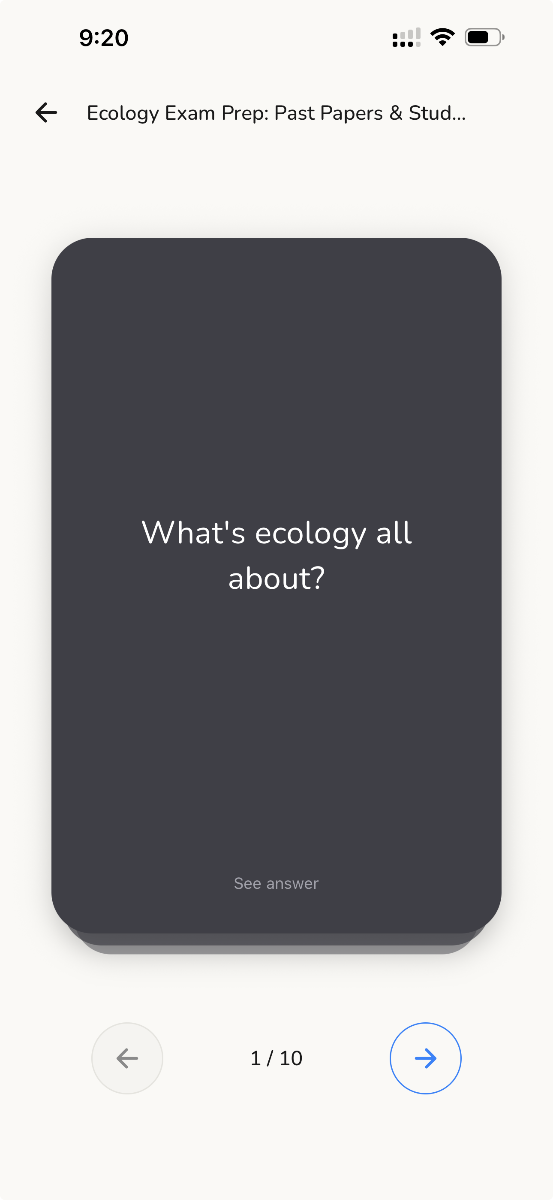
Tap to Flip
No buttons. No menus. Just tap the card to reveal the answer and see the "why it matters" explanation.
Swipe to Navigate
Finished with a card? Swipe right to move to the next one. Want to go back? Swipe left. It's as intuitive as scrolling through Instagram.
Auto-Save Progress
Life happens. Your roommate needs a ride. Your mom calls. You remember you have a paper due tomorrow.
Close the app mid-study session and Brigo automatically remembers exactly where you left off. When you come back (even days later), you'll pick up right where you stopped. No lost progress. No frustration.
Smart Shuffling
Brigo automatically shuffles your deck each time you study so you're not just memorizing the order of cards. Your brain has to actually know the content, not just predict what's coming next.
Your Study Buddy: The Daily 5 Challenge
Let's be honest: most people fail at studying consistently because it feels overwhelming.
"I need to study for three hours tonight." (Doesn't happen) "I'll make flashcards this weekend." (Also doesn't happen)
The secret to building a study habit isn't motivation. It's making it so easy you'd feel silly NOT doing it.
That's why Brigo has the Daily 5 Challenge.
Complete just 5 flashcards every day. That's it. No marathon study sessions required.
Here's what happens when you do:
1. You Feed Your Pet Your Brigo companion (your pet) depends on you to complete daily tasks. Finishing 5 cards keeps them healthy and happy. It sounds silly, but this tiny bit of accountability actually works. Students don't want to let their pet down.
2. You Build Your Streak Every day you complete the Daily 5, your streak counter goes up. Watch that number climb from 1 to 7 to 30 to 100. Breaking a long streak feels terrible (in a motivating way). Keeping it alive feels amazing.
3. You Actually Learn Five cards takes less than 2 minutes. But do it every single day for a month and you've reviewed 150+ concepts. That's the power of consistency over intensity.
The best part? You can knock out your Daily 5 anywhere:
Waiting for your coffee order
On the bus to campus
During a boring lecture (we won't tell)
Right before bed
No excuses. Two minutes. Five cards. Better grades.
Real Example: How Marcus Used Flashcards to Save His Semester
Marcus, a first-year medical student, was drowning in Anatomy.
Every week brought new terminology: muscles, bones, nerves, blood vessels. He tried highlighting his textbook (didn't work). He tried rewriting his notes (took forever and he still forgot everything).
Two weeks before his midterm, he was failing.
What he did:
Uploaded 6 weeks of Anatomy lecture slides to Brigo
Generated a flashcard deck (285 cards created in 45 seconds)
Committed to the Daily 5 challenge
His routine:
5 cards every morning during breakfast
10-15 cards during his commute
Another 10 cards before bed
He wasn't studying for hours. He was studying in micro-sessions throughout the day, forcing his brain to actively retrieve information over and over.
The result: Marcus scored an 87% on his midterm. Not because he suddenly became smarter. Not because he pulled an all-nighter. But because he used a study method that actually works.
As he put it: "I stopped pretending to study and started actually learning."
Pro Tips: Getting the Most from Your Flashcards
Tip 1: Quality Over Quantity with Your Source Material
You don't need to upload your entire textbook. A single set of well-organized lecture notes is often better than 10 random documents.
Why? Because Brigo creates better cards when it has focused, coherent material to work with. Your professor's lecture slides hit the key points they think are important. That's gold for flashcard generation.
Tip 2: Always Read the Explanation
When you flip a card, you'll see:
The answer
An explanation of why it's correct
Sometimes, context that connects it to other concepts
Don't skip the explanation. That's where the real learning happens. The explanation turns memorization into understanding.
Weak study habit: Read question → flip → check if you were right → move on
Strong study habit: Read question → flip → check answer → read full explanation → think about how this connects to other topics you've learned
Tip 3: Use Spaced Repetition (Brigo Does This Automatically)
Here's a secret about memory: you forget things. A lot. Quickly.
But if you review something right before you're about to forget it, you remember it much longer. Review it again right before the next forgetting point? Even longer retention.
This is called spaced repetition, and it's the most scientifically-proven way to move information from short-term to long-term memory.
Brigo's flashcard system is built on spaced repetition principles. Cards you struggle with appear more frequently. Cards you know well appear less often. You're always studying exactly what you need to study.
Tip 4: Don't Just Memorize the Answer, Understand It
If you can recite the answer but can't explain it to a friend in your own words, you haven't really learned it.
Use Brigo's flashcards as a starting point, not the finish line. When you get a card right, ask yourself:
Can I explain this to someone else?
How does this connect to what I learned last week?
Where might this show up on my exam?
Tip 5: Create Progressive Decks Throughout the Semester
Don't wait until two weeks before finals to make flashcards.
Best practice: After each lecture or study session, upload your notes to Brigo and generate a small deck. Study those cards for a few days while the material is fresh.
By the time finals arrive, you won't be learning new material. You'll just be reinforcing what you already know. That's the difference between panic-studying and confident-studying.
Common Mistakes (And How to Avoid Them)
Mistake 1: Creating Cards But Never Reviewing Them
Making flashcards feels productive. It feels like studying. But if you never actually review them, you've wasted your time.
The fix: Let Brigo create your cards in seconds, then spend your time actually studying them instead of making them.
Mistake 2: Only Studying Cards You Already Know
It's tempting to skip the hard cards and keep reviewing the easy ones. It feels good to get answers right.
But you don't grow by practicing what you already know. You grow by struggling with what you don't know.
The fix: When a card stumps you, that's your brain's signal saying "this is important, learn this." Don't skip it. Embrace the struggle.
Mistake 3: Passive Flipping
Some students flip through cards like they're scrolling social media. Question, answer, next. Question, answer, next.
No thinking. No engagement. Just motion.
The fix: Before flipping each card, actually try to answer it out loud (or in your head). Make your brain work for it. The effort is what builds memory.
FAQ: Your Flashcard Questions Answered
Q: How many flashcards will Brigo create from my notes?
A: It depends on the length and density of your material. A typical 10-page lecture note set generates 40-80 cards. A full textbook chapter might generate 100-150 cards.
Q: Can I edit the flashcards Brigo creates?
A: Yes! While Brigo creates high-quality cards automatically, you can always edit them to match your learning style or add personal examples.
Q: What if I only have 5 minutes to study?
A: Perfect. Do your Daily 5. That's exactly what this system is designed for. Consistent micro-sessions beat inconsistent marathon sessions every time.
Q: Will flashcards work for subjects like Math or Physics?
A: Absolutely. Brigo creates cards for formulas, problem-solving steps, and conceptual understanding. For calculation-heavy subjects, flashcards help you memorize formulas and understand when to apply them.
Q: I've tried flashcards before and quit. Why will this be different?
A: Because you probably spent hours making cards instead of studying them. Brigo eliminates the friction. Upload notes, generate cards in seconds, study anywhere. The easier it is, the more likely you'll stick with it.
---
The Research Behind Active Recall
Want to dive deeper into the science? Here are some studies that prove flashcards work:
- The Critical Importance of Retrieval for Learning (Science Journal)
- Improving Students' Learning With Effective Learning Techniques
- The Spacing Effect - Cornell University
These aren't just theories. This is proven science.
The Bottom Line: Stop Pretending, Start Learning
Passive studying feels comfortable. Reading feels like progress. Highlighting feels productive.
But feeling productive and actually learning are two completely different things.
Active recall through flashcards is uncomfortable. Your brain has to work. You'll get answers wrong. You'll feel frustrated.
And that's exactly why it works.
Ready to turn your study notes into a learning machine?
Open any notebook in Brigo
Tap the Studio tab
Select "Generate Flashcards"
Start your Daily 5 challenge today
Your brain will thank you. Your GPA will thank you. And your pet will definitely thank you.
Questions about flashcards? Email us at support@brigo.app.
New to Brigo? Download the app and generate your first deck free.