
How to Study When You Have No Motivation: 7 Tricks That Actually Work (2026)

You're sitting at your desk. Your textbook is open. Your notes are ready. Your coffee is hot.
And you feel... nothing.
Not tired. Not anxious. Just completely, utterly unmotivated.
You know you should study. The exam is in three days. You're behind. But your brain feels like it's wrapped in cotton. Every time you try to focus, your mind wanders. You read the same paragraph four times and retain nothing.
So you scroll Instagram instead. Watch TikToks. Reorganize your desk. Suddenly cleaning your room seems fascinating.
Then the guilt hits. "Why can't I just study? What's wrong with me?"
Here's what I need you to hear: Nothing is wrong with you.
Lack of motivation isn't a character flaw. It's not laziness. It's not weakness.
It's your brain responding to modern life in completely predictable ways. And once you understand why motivation disappears, you can build systems that work even when you feel nothing.
In this post, I'm sharing 7 science-backed strategies that help you study when motivation is gone. Not "rah rah you can do it" toxic positivity. Real, practical techniques that actually work.
Let's fix this.
Why You Actually Have No Motivation (It's Not Your Fault)
Before we get to solutions, let's talk about why motivation vanishes in the first place.
The Dopamine Problem
Your brain runs on dopamine. It's the neurotransmitter that makes you feel motivated, focused, and energized.
Here's the problem: modern life is a dopamine slot machine.
Every time you check your phone: Social media gives you tiny dopamine hits (likes, comments, notifications) YouTube autoplay keeps you watching "just one more video" TikTok's algorithm is engineered to be addictive Games, messages, endless scrolling
Your brain gets used to constant, instant stimulation. Studying can't compete. Reading a textbook feels like watching paint dry compared to the dopamine fireworks of your phone.
Research from UCLA shows that heavy social media use literally rewires your brain's reward system, making focused work feel unbearable.
You're not weak. You're fighting an uphill battle against apps designed by neuroscientists to be addictive.
Decision Fatigue
By the time you sit down to study, you've already made hundreds of decisions today:
What to wear. What to eat. Which assignment to start with. Should I reply to that text? Should I go to that party? What should I study first?
Every decision depletes your mental energy. By evening, you're running on fumes. Your brain literally doesn't have the energy to make one more decision (like "should I study Chapter 7 or Chapter 8?").
This is called decision fatigue, and it kills motivation dead.
The Burnout Cycle
Maybe you studied hard last semester. Got good grades. Felt accomplished.
Then this semester hit, and suddenly... you can't do it anymore. The tank is empty.
This is burnout. It's not laziness. It's your brain saying "we need rest, not more productivity."
Ignoring burnout and trying to force yourself to study just makes it worse.
The Motivation Myth
Here's the biggest secret about motivation: You don't need it.
Seriously.
Motivation is unreliable. It comes and goes. Waiting for motivation before you study is like waiting for perfect weather before you leave the house.
What you actually need is a system that works even when motivation is at zero.
Professional athletes don't wait to feel motivated before practice. They have a system. They show up regardless of how they feel.
That's what we're building here.
The 7 Science-Backed Tricks (That Actually Work)
Trick #1: The 2-Minute Rule (Just Start for 2 Minutes)
The hardest part of studying isn't the studying. It's the starting.
Your brain resists because it imagines studying as this huge, exhausting task. Three hours of reading. Hundreds of flashcards. Mountains of notes.
No wonder you feel unmotivated.
The 2-Minute Rule says: Commit to studying for just 2 minutes. That's it.
Not 30 minutes. Not an hour. Two minutes.
Tell yourself: "I'll just read one page. If I still feel terrible after 2 minutes, I can stop."
Why this works:
Starting is the hardest part. Once you're in motion, continuing is easier (physics calls this inertia).
Studies on habit formation show that 80% of the time, once you start a 2-minute task, you keep going. Your brain shifts from resistance mode to flow mode.
How to use it:
Set a timer for 2 minutes. Open your notes or textbook. Start reading or reviewing. When the timer goes off, ask yourself: "Can I do 2 more minutes?"
Usually, the answer is yes.
Brigo version: Open the app and commit to just 5 flashcards (the Daily 5). Takes less than 2 minutes. But once you start, you'll often keep going.
Trick #2: Temptation Bundling (Pair Studying with Something You Enjoy)
Your brain wants pleasure. Studying doesn't feel pleasurable. So your brain avoids it.
Solution: Bundle studying with something you actually enjoy.
This is called temptation bundling, and research from the University of Pennsylvania shows it significantly increases task completion.
Examples:
Study at your favorite coffee shop (you get coffee + atmosphere you love) Listen to instrumental music or lo-fi beats while reviewing notes Burn a candle you like while studying Wear your comfiest clothes Study in a cozy spot (not at a boring desk)
Advanced version: Only allow yourself to watch your favorite show WHILE doing low-focus tasks like reviewing flashcards or organizing notes.
The key: pair the "should do" task (studying) with a "want to do" reward (coffee, music, comfort).
Your brain starts associating studying with positive feelings instead of dread.
Brigo version: Turn your study notes into audio and listen while doing something enjoyable (walking, commuting, cooking). Your brain gets stimulation from the activity while absorbing information.
Trick #3: The Daily 5 Method (Micro-Commitments Beat Motivation)
Big goals feel overwhelming. "Study for 3 hours" makes you want to hide under the covers.
But "study 5 flashcards"? That feels doable even when you're exhausted.
The Daily 5 Method:
Every day, commit to studying just 5 things. Not 50. Not 500. Five.
5 flashcards. 5 practice problems. 5 pages. Whatever works for your subject.
Why this works:
Consistency beats intensity. Studying 5 flashcards every day for 30 days (150 total) beats cramming 150 flashcards in one miserable session.
Small wins build momentum. Each day you complete your Daily 5, you prove to yourself "I can do this." Confidence grows.
No motivation required. When the bar is this low, you can do it even on your worst days.
The science:
Research on habit formation shows that small, daily actions are more sustainable than occasional big efforts. BJ Fogg's Tiny Habits method proves that starting tiny is the key to long-term change.
Brigo's Daily 5 Challenge:
Open the app. Study 5 flashcards. Done.
Your pet stays happy. Your streak continues. Your brain gets a dopamine hit from completion (not from your phone, from actual progress).
Do this for 7 days and watch what happens. You'll start to feel like a person who studies, not a person who struggles to study.
Learn more about how flashcards work
Trick #4: Environment Design (Make It Easier to Study Than Not To)
Willpower is overrated. Environment design is underrated.
If your phone is next to you, you'll check it. If your bed is nearby, you'll lie down. If your notes are buried in your bag, you won't study.
Change your environment, change your behavior.
Remove friction from studying:
Leave your textbook open to the page you need to read. (When you sit down, it's already there. No decisions needed.)
Pre-load Brigo with today's flashcards so you just tap and start.
Put your phone in another room. Seriously. Out of sight, out of mind.
Set up a "study corner" with everything you need already there (pens, water, charger, notes).
Add friction to distractions:
Delete social media apps from your phone (or use app blockers during study hours).
Log out of Netflix/YouTube so you have to actively log back in (that extra step is often enough to stop you).
Turn off all notifications.
Why this works:
Research in behavioral psychology shows that environment shapes behavior more than willpower does. You're not weak. Your environment is set up to make distraction easy and studying hard.
Flip it. Make studying the path of least resistance.
Trick #5: The Pomodoro Technique (Work in Sprints, Not Marathons)
Your brain can't focus intensely for 3 hours straight. Trying to force it just leads to burnout and frustration.
Instead, work in sprints.
The Pomodoro Technique:
Set a timer for 25 minutes. Study with full focus (no phone, no distractions). When the timer goes off, take a 5-minute break. Repeat 4 times, then take a longer 15-30 minute break.
Why this works:
Your brain can handle 25 minutes of focus even when motivation is low. It's a sprint, not a marathon.
Breaks prevent burnout. Knowing a break is coming makes it easier to push through.
The timer creates urgency. You're racing the clock, which triggers focus.
Studies on the Pomodoro Technique show that it improves concentration and reduces mental fatigue.
Pro tip: During your 5-minute break, move your body. Walk around. Stretch. Do jumping jacks. Physical movement resets your brain and boosts dopamine naturally.
Don't scroll your phone during breaks. That kills your focus for the next Pomodoro.
Trick #6: Accountability Systems (Use Pets, Streaks, Friends)
Motivation is internal and unreliable. Accountability is external and consistent.
When you're only accountable to yourself, it's easy to quit. "I'll just study tomorrow."
But when someone (or something) else is depending on you? That changes things.
Ways to build accountability:
Study buddies: Text a friend "I'm studying for 30 minutes starting now." Check in when done. You don't want to let them down.
Public commitment: Post on social media "studying for my exam today" (peer pressure is motivating).
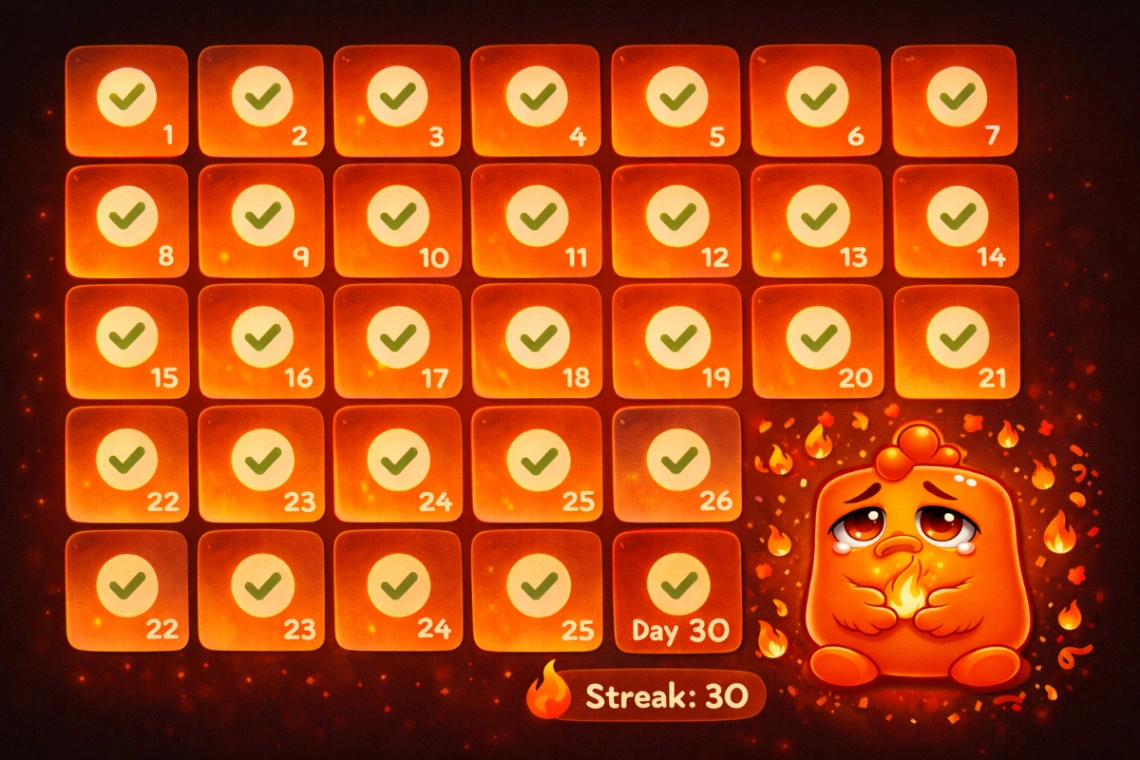
Gamification: Use apps that track streaks. Breaking a 15-day streak feels terrible (in a good way). You'll study just to keep it alive.
Brigo's Pet System: Your pet depends on you completing your Daily 5. Miss a day and your pet gets sad. It sounds silly, but students report they study just so their pet stays happy. Emotional accountability works.
The science:
Research on commitment devices shows that external accountability increases follow-through by up to 33%. When you make your goals public or tie them to something external, you're more likely to complete them.
Trick #7: Reframe Your "Why" (Connect Studying to What You Actually Care About)
"I need to study for this exam" is abstract and unmotivating.
But "I need to pass this class to get into med school so I can help people" hits different.
When you're unmotivated, it's often because you've lost sight of why you're doing this in the first place.
Reconnect to your real why:
Not "I should get good grades" (external, boring).
But "I want to become a nurse so I can make a difference" (internal, meaningful).
Not "I need to pass this test" (short-term pressure).
But "I'm building skills that will help me in my career" (long-term purpose).
Ask yourself:
Why did I choose this major? What do I want to do after graduation? Who am I doing this for? (Yourself? Your family? Future patients?)
Write it down. Put it somewhere visible.
When motivation crashes, read your why. It won't magically fix everything, but it helps you remember that this temporary discomfort serves a bigger purpose.
Warning: If you genuinely can't find a meaningful "why," that's a signal. Maybe you're in the wrong major. Maybe you need to reassess your goals. That's okay. Better to realize it now than after graduation.
What NOT to Do (Common Mistakes That Make It Worse)
Don't Wait for Motivation to Strike
Motivation doesn't just appear. It's a byproduct of action, not a prerequisite.
Start studying, and motivation often follows. Wait for motivation, and you'll wait forever.
Don't Rely on Willpower Alone
Willpower is a limited resource. By 8 PM, you're running on empty.
Build systems (environment design, Daily 5, accountability) so you don't need willpower.
Don't Compare Yourself to "Motivated" Students
That student who seems endlessly motivated? They probably have systems you don't see. Or they're struggling privately just like you.
Comparison kills motivation. Focus on your own progress.
Don't Study for Hours When You're Burnt Out
If you're genuinely burnt out, forcing yourself to study for 5 hours won't work. You'll stare at notes and retain nothing.
Better strategy: Take a real break (a day or two), then come back with the Daily 5 method. Quality over quantity.
Emergency Motivation Rescue (When You Have an Exam Tomorrow)
Okay, worst case scenario: Your exam is tomorrow and you have zero motivation.
Emergency protocol:
Step 1: Acknowledge the panic, then let it go. Panicking wastes energy.
Step 2: Use the 2-Minute Rule. Just start. Set a timer for 2 minutes and begin.
Step 3: Focus only on high-priority material. Use Brigo's Exam Prediction to identify what actually matters. Don't try to study everything.
Step 4: Use Pomodoros. 25 minutes on, 5 minutes off. Your brain can handle this even in crisis mode.
Step 5: Temptation bundle. Study at a place you love with a drink you enjoy. Make it as pleasant as possible.
Step 6: Get 5-6 hours of sleep. Don't pull an all-nighter. Sleep is when your brain consolidates information.
You won't be perfectly prepared, but you'll be functional. And functional beats paralyzed-by-lack-of-motivation.
Read our complete guide on how to study for a test in one day
FAQ: Your Motivation Questions Answered
Q: Is it normal to have no motivation to study?
A: Completely normal. Modern students are dealing with social media addiction, decision fatigue, burnout, and anxiety at unprecedented levels. Your brain is functioning exactly as expected given the circumstances.
Q: What if I'm depressed, not just unmotivated?
A: If lack of motivation is paired with hopelessness, inability to feel joy, changes in sleep/appetite, or thoughts of self-harm, please talk to a counselor or therapist.
Find mental health resources here or contact your campus counseling center.
Depression is medical, not motivational. That said, even with depression, small systems (like Daily 5) can help. Start tiny. Get professional support.
Q: How do I stay motivated long-term?
A: You don't. Stop chasing motivation. Build systems instead:
Daily 5 (consistency beats intensity) Environment design (make studying easy, distractions hard) Accountability (streaks, pets, study buddies) Connection to purpose (remember your why)
Motivation will come and go. Systems work regardless.
Q: What if I try all these tricks and still can't study?
A: Two possibilities:
You're genuinely burnt out and need rest (take a real break, then start with Daily 5).
You might be in the wrong major/path (and that's okay to reassess).
But try the systems first. Most students are surprised how much easier studying becomes with the right approach.
The Bottom Line: Motivation Is Overrated, Systems Are Underrated
Here's what nobody tells you: Successful students aren't more motivated than you.
They just have better systems.
They don't rely on feeling motivated. They've built habits that work on autopilot.
They study when they're tired. When they're stressed. When they'd rather do anything else. Because their systems carry them through.
You can build those systems too.
Start with one:
Try the 2-Minute Rule today.
Commit to Daily 5 for one week.
Design your environment to remove one distraction.
Just one change. See what happens.
Ready to build a study system that works even when motivation is zero?
Download Brigo and start the Daily 5 Challenge. Study just 5 flashcards a day. Watch your streak grow. Let your pet keep you accountable.
Motivation is optional. Progress is guaranteed.
Questions? Email us at support@brigo.app
New to Brigo? Learn how the app works or read our origin story.
The Research Behind These Strategies
Want to dive deeper into the science of motivation and habit formation?
The Science of Willpower and Self-Control - Research on decision fatigue and willpower depletion
Tiny Habits by BJ Fogg - How small actions create lasting change
Dopamine and Social Media Use - Study on how social media affects motivation
The Pomodoro Technique Research - Evidence for timed focus sessions
Behavioral Economics and Commitment Devices - How external accountability improves follow-through
These aren't just tips. This is proven science applied to studying.
Stop waiting for motivation. Start building systems. Download Brigo and take the first step today.